Showing posts with label Poetry. Show all posts

Wednesday, 16 April 2014

Sirens

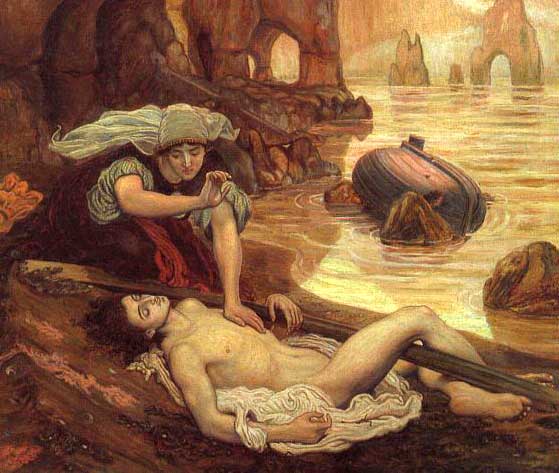
Edward Matthew Hale: The Sirens

   The sea is lonely, the sea is dreary, 
The sea is restless and uneasy; 
Thou seekest quiet, thou art weary, 
Wandering thou knowest not whither;— 
Our little isle is green and breezy, 
Come and rest thee! Oh come hither, 
Come to this peaceful home of ours, 
      Where evermore 
The low west-wind creeps panting up the shore 
To be at rest among the flowers; 
Full of rest, the green moss lifts, 
   As the dark waves of the sea 
Draw in and out of rocky rifts, 
   Calling solemnly to thee 
With voices deep and hollow,— 
      "To the shore 
   Follow! Oh, follow! 
   To be at rest forevermore! 
         Forevermore!" 

Look how the gray old Ocean 
From the depth of his heart rejoices, 
Heaving with a gentle motion, 
When he hears our restful voices; 
List how he sings in an undertone, 
Chiming with our melody; 
And all sweet sounds of earth and air 
Melt into one low voice alone, 
That murmurs over the weary sea, 
And seems to sing from everywhere,— 
"Here mayst thou harbor peacefully, 
Here mayst thou rest from the aching oar; 
   Turn thy curvëd prow ashore, 
And in our green isle rest forevermore! 
         Forevermore!" 
And Echo half wakes in the wooded hill, 
   And, to her heart so calm and deep, 
   Murmurs over in her sleep, 
Doubtfully pausing and murmuring still, 
         "Evermore!" 
      Thus, on Life's weary sea, 
      Heareth the marinere 
      Voices sweet, from far and near, 
      Ever singing low and clear, 
      Ever singing longingly. 

   It is not better here to be, 
Than to be toiling late and soon? 
In the dreary night to see 
Nothing but the blood-red moon 
Go up and down into the sea; 
Or, in the loneliness of day, 
   To see the still seals only 
Solemnly lift their faces gray, 
   Making it yet more lonely? 
Is it not better than to hear 
Only the sliding of the wave 
Beneath the plank, and feel so near 
A cold and lonely grave, 
A restless grave, where thou shalt lie 
Even in death unquietly? 
Look down beneath thy wave-worn bark, 
   Lean over the side and see 
The leaden eye of the sidelong shark
      Upturnëd patiently, 
   Ever waiting there for thee: 
Look down and see those shapeless forms, 
   Which ever keep their dreamless sleep 
   Far down within the gloomy deep, 
And only stir themselves in storms, 
Rising like islands from beneath, 
And snorting through the angry spray, 
As the frail vessel perisheth 
In the whirls of their unwieldy play; 
   Look down! Look down! 
Upon the seaweed, slimy and dark, 
That waves its arms so lank and brown, 
      Beckoning for thee! 
Look down beneath thy wave-worn bark 
      Into the cold depth of the sea! 
   Look down! Look down! 
      Thus, on Life's lonely sea, 
      Heareth the marinere 
      Voices sad, from far and near, 
      Ever singing full of fear, 
      Ever singing dreadfully. 

   Here all is pleasant as a dream; 
The wind scarce shaketh down the dew, 
The green grass floweth like a stream 
         Into the ocean's blue; 
            Listen! Oh, listen! 
Here is a gush of many streams, 
   A song of many birds, 
And every wish and longing seems 
Lulled to a numbered flow of words,— 
            Listen! Oh, listen! 
Here ever hum the golden bees 
Underneath full-blossomed trees, 
At once with glowing fruit and flowers crowned;— 
So smooth the sand, the yellow sand, 
That thy keel will not grate as it touches the land; 
All around with a slumberous sound, 
The singing waves slide up the strand, 
And there, where the smooth, wet pebbles be 
The waters gurgle longingly, 
As if they fain would seek the shore, 
To be at rest from the ceaseless roar, 
To be at rest forevermore,— 
         Forevermore. 
      Thus, on Life's gloomy sea, 
      Heareth the marinere 
      Voices sweet, from far and near, 
      Ever singing in his ear, 
      "Here is rest and peace for thee!"

(The Sirens - by James Russell Lowell)

Wednesday, 26 March 2014

The Progress of Spring

Charles Daniel Ward: The Progress of Spring

The Progress of Spring
by Lord Alfred Tennyson

The groundflame of the crocus breaks the mould,
Fair Spring slides hither o'er the Southern sea,
Wavers on her thin stem the snowdrop cold
That trembles not to kisses of the bee:
Come Spring, for now from all the dripping eaves
The spear of ice has wept itself away,
And hour by hour unfolding woodbine leaves
O'er his uncertain shadow droops the day.
She comes! The loosen'd rivulets run;
The frost-bead melts upon her golden hair;
Her mantle, slowly greening in the Sun,
Now wraps her close, now arching leaves her bar
To breaths of balmier air;
Up leaps the lark, gone wild to welcome her,
About her glance the tits, and shriek the jays,
Before her skims the jubilant woodpecker,
The linnet's bosom blushes at her gaze,
While round her brows a woodland culver flits,
Watching her large light eyes and gracious looks,
And in her open palm a halcyon sits
Patient--the secret splendour of the brooks.
Come Spring! She comes on waste and wood,
On farm and field: but enter also here,
Diffuse thyself at will thro' all my blood,
And, tho' thy violet sicken into sere,
Lodge with me all the year!

Once more a downy drift against the brakes,
Self-darken'd in the sky, descending slow!
But gladly see I thro' the wavering flakes
Yon blanching apricot like snow in snow.
These will thine eyes not brook in forest-paths,
On their perpetual pine, nor round the beech;
They fuse themselves to little spicy baths,
Solved in the tender blushes of the peach;
They lose themselves and die
On that new life that gems the hawthorn line;
Thy gay lent-lilies wave and put them by,
And out once more in varnish'd glory shine
Thy stars of celandine.

She floats across the hamlet. Heaven lours,
But in the tearful splendour of her smiles
I see the slowl-thickening chestnut towers
Fill out the spaces by the barren tiles.
Now past her feet the swallow circling flies,
A clamorous cuckoo stoops to meet her hand;
Her light makes rainbows in my closing eyes,
I hear a charm of song thro' all the land.
Come, Spring! She comes, and Earth is glad
To roll her North below thy deepening dome,
But ere thy maiden birk be wholly clad,
And these low bushes dip their twigs in foam,
Make all true hearths thy home.

Across my garden! and the thicket stirs,
The fountain pulses high in sunnier jets,
The blackcap warbles, and the turtle purrs,
The starling claps his tiny castanets.
Still round her forehead wheels the woodland dove,
And scatters on her throat the sparks of dew,
The kingcup fills her footprint, and above
Broaden the glowing isles of vernal blue.
Hail ample presence of a Queen,
Bountiful, beautiful, apparell'd gay,
Whose mantle, every shade of glancing green,
Flies back in fragrant breezes to display
A tunic white as May!

She whispers, 'From the South I bring you balm,
For on a tropic mountain was I born,
While some dark dweller by the coco-palm
Watch'd my far meadow zoned with airy morn;
From under rose a muffled moan of floods;
I sat beneath a solitude of snow;
There no one came, the turf was fresh, the woods
Plunged gulf on gulf thro' all their vales below
I saw beyond their silent tops
The steaming marshes of the scarlet cranes,
The slant seas leaning oll the mangrove copse,
And summer basking in the sultry plains
About a land of canes;

'Then from my vapour-girdle soaring forth
I scaled the buoyant highway of the birds,
And drank the dews and drizzle of the North,
That I might mix with men, and hear their words
On pathway'd plains; for--while my hand exults
Within the bloodless heart of lowly flowers
To work old laws of Love to fresh results,
Thro' manifold effect of simple powers--
I too would teach the man
Beyond the darker hour to see the bright,
That his fresh life may close as it began,
The still-fulfilling promise of a light
Narrowing the bounds of night.'

So wed thee with my soul, that I may mark
The coming year's great good and varied ills,
And new developments, whatever spark
Be struck from out the clash of warring wills;
Or whether, since our nature cannot rest,
The smoke of war's volcano burst again
From hoary deeps that belt the changeful West,
Old Empires, dwellings of the kings of men;
Or should those fail, that hold the helm,
While the long day of knowledge grows and warms,
And in the heart of this most ancient realm
A hateful voice be utter'd, and alarms
Sounding 'To arms! to arms!'

A simpler, saner lesson might he learn
Who reads thy gradual process, Holy Spring.
Thy leaves possess the season in their turn,
And in their time thy warblers rise on wing.
How surely glidest thou from March to May,
And changest, breathing it, the sullen wind,
Thy scope of operation, day by day,
Larger and fuller, like the human mind '
Thy warmths from bud to bud
Accomplish that blind model in the seed,
And men have hopes, which race the restless blood
That after many changes may succeed
Life, which is Life indeed.

Sunday, 9 February 2014

Way to Mandalay

Herbert James Draper: The Vintage Morn

Where the wave of moonlight glosses
The dim gray sands with light,
Far off by furthest Rosses
We foot it all the night,
Weaving olden dances
Mingling hands and mingling glances
Till the moon has taken flight;
To and fro we leap
And chase the frothy bubbles,
While the world is full of troubles
And anxious in its sleep.
(From W.B. Yeats - The stolen child)

Wednesday, 1 January 2014

A cry for the new world

Sir Joseph Noel Paton: I Wonder Who Lived In There

I Would I Were a Careless Child
(George Gordon, Lord Byron)

I would I were a careless child,
Still dwelling in my Highland cave,
Or roaming through the dusky wild,
Or bounding o’er the dark blue wave;
The cumbrous pomp of Saxon pride
Accords not with the freeborn soul,
Which loves the mountain’s craggy side,
And seeks the rocks where billows roll.

Fortune! take back these cultured lands,
Take back this name of splendid sound!
I hate the touch of servile hands,
I hate the slaves that cringe around.
Place me among the rocks I love,
Which sound to Ocean’s wildest roar;
I ask but this — again to rove
Through scenes my youth hath known before.

Few are my years, and yet I feel
The world was ne’er designed for me:
Ah! why do dark’ning shades conceal
The hour when man must cease to be?
Once I beheld a splendid dream,
A visionary scene of bliss:
Truth! — wherefore did thy hated beam
Awake me to a world like this?

I loved — but those I love are gone;
Had friends — my early friends are fled:
How cheerless feels the heart alone,
When all its former hopes are dead!
Though gay companions o’er the bowl
Dispel awhile the sense of ill;
Though pleasure stirs the maddening soul,
The heart — the heart — is lonely still.

How dull! to hear the voice of those
Whom rank or chance, whom wealth or power,
Have made, though neither friends nor foes,
Associates of the festive hour.
Give me again a faithful few,
In years and feelings still the same,
And I will fly the midnight crew,
Where boist’rous joy is but a name.

And woman, lovely woman! thou,
My hope, my comforter, my all!
How cold must be my bosom now,
When e’en thy smiles begin to pall!
Without a sigh would I resign
This busy scene of splendid woe,
To make that calm contentment mine,
Which virtue know, or seems to know.

Fain would I fly the haunts of men —
I seek to shun, not hate mankind;
My breast requires the sullen glen,
Whose gloom may suit a darken’d mind.
Oh! that to me the wings were given
Which bear the turtle to her nest!
Then would I cleave the vault of heaven,
To flee away, and be at rest.

Thursday, 19 December 2013

The Broken Sword

John Howe - Aragorn

All that is gold does not glitter,
Not all those who wander are lost;
The old that is strong does not wither,
Deep roots are not reached by the frost.
From the ashes a fire shall be woken,
A light from the shadows shall spring;
Renewed shall be blade that was broken,
The crownless again shall be king
(J.R.R. Tolkien)


(Mystery - Broken Sword)

Friday, 6 December 2013

War in Heaven

Luca Giordano: The Fall of the Rebel Angels

They rise from this fiery region,
On dragon-like wings, by thousands they've come to war.
And dark are the Seraphic Legions,
With armor and shield, they raise their flaming swords.
In the name of the Archangel Lucifer
The Legions hath come, to divide and to conquer
Thy kingdom, Thy power, Thy throne,
The Seraphic legions they goe . . .

The celestial armies of heaven,
Descend from the Sovereign's sky forth God's command.
And lo, Michael with sword in hand,
He leads the Lordian Guard to slay to damn.
In the name of the Almighty Father,
The angels hath come to cast out the Legions
Forever, to the infernal realm,
From heaven to hell . . .

On chariots of thunder and lightning,
On Lordian Steeds the angels smite their foe.
And the Seraph they fall to destruction,
As the hounds and the carrion of hell feast on their corpse.
Now lost is the Archangel Lucifer,
Who thought in his mind, he could rise to Empyrean dominion
'Til fate was his foe,
The will of God his woe . . .

Monday, 11 November 2013

Live by the sword - Die by the sword

Justin Sweet: Conan the Cimmerian

...........
There, where death's brief pang was quickest,
And the battle's wreck lay thickest,
Strewed beneath the advancing banner
Of the eagle's burning crest—
(There with thunder-clouds to fan her,
Who could then her wing arrest—
Victory beaming from her breast?)
While the broken line enlarging
Fell, or fled along the plain;
There be sure was Murat charging!
There he ne'er shall charge again!
O'er glories gone the invaders march,
Weeps Triumph o'er each levelled arch—
But let Freedom rejoice,
With her heart in her voice;
But, her hand on her sword,
Doubly shall she be adored;
........
(From "Ode From The French" by George Gordon, Lord Byron)

(Sword - Children of Heaven)

Wednesday, 6 November 2013

Race of Cain

Valentine Cameron Prinsep: A Venetian Gaming House in the Sixteenth Century

(Charles Baudelaire's Fleurs du mal / Flowers of Evil - Abel and Cain)
(Translation - Roy Campbell)

Race of Abel! eat, sleep, drink. 
God smiles on those that he prefers. 
Race of Cain!in swamps that stink, 
Crawl, and die the death of curs. 
Race of Abel! your crops sprout, 
And your flocks are safe and sound. 
Race of Cain! your guts howl out 
In hunger, like an ancient hound. 
Race of Abel! warm your guts 
At the patriarchal fire. 
Race of Cain! in caves and huts 
Shiver like jackals in the mire. 
Race of Abel! Pullulate : 
Your gold too procreates its kind. 
Race of Cain! Hearts hot with hate, 
Leave all such appetites behind. 
Race of Abel! grow and graze, 
Like woodlice that on timbers prey. 
Race of Cain! along rough ways 
Lead forth your family at bay.

Ah! Race of Abel! your fat carrion 
Will well manure the soil it presses. 
Race of Cain! One task to carry on 
Remains for you, a task that presses. 
Race of Abel! Shame is nigh. 
The coulter's beaten by the sword. 
Race of Cain, climb up the sky, 
And to the earth hurl down the Lord.

Friday, 1 November 2013

But who, alas! can love, and then be wise?

Francesco Hayez : The Kiss

(George Gordon Noel, 6th Baron Byron: Don Juan)

'T was on the sixth of June, about the hour
   Of half-past six --- perhaps still nearer seven ---
When Julia sate within as pretty a bower
   As e'er held houri in that heathenish heaven
Described by Mahomet, and Anacreon Moore,
   To whom the lyre and laurels have been given, 
With all the trophies of triumphant song ---
He won them well, and may he wear them long!

She sate but not alone; I know not well
   How this same interview had taken place,
And even if I knew, I should not tell ---
   People should hold their tongues in any case;
No matter how or why the thing befell,
   But there were she and Juan, face to face ---
When two such faces are so, 't would be wise, 
But very difficult, to shut their eyes.

How beautiful she look'd! her conscious heart 
   Glow'd in her cheek, and yet she felt no wrong.
Oh Love! how perfect is thy mystic art,
   Strengthening the weak, and trampling on the strong,
How self-deceitful is the sagest part
    Of mortals whom thy lure hath led along ---
The precipice she stood on was immense,
So was her creed in her own innocence.

She thought of her own strength, and Juan's youth,
   And of the folly of all prudish fears,
Victorious virtue, and domestic truth,
   And then of Don Alfonso's fifty years:
I wish these last had not occurr'd, in sooth,
   Because that number rarely much endears,
And through all climes, the snowy and the sunny,
Sounds ill in love, whate'er it may in money.

When people say, "I've told you fifty times,"
   They mean to scold, and very often do;
When poets say, "I've written fifty rhymes,"
   They make you dread that they 'II recite them too;
In gangs of fifty, thieves commit their crimes;
   At fifty love for love is rare, 't is true,
But then, no doubt, it equally as true is,
A good deal may be bought for fifty Louis.

Julia had honour, virtue, truth, and love,
   For Don Alfonso; and she inly swore,
By all the vows below to powers above,
   She never would disgrace the ring she wore,
Nor leave a wish which wisdom might reprove;
   And while she ponder'd this, besides much more,
One hand on Juan's carelessly was thrown,
Quite by mistake --- she thought it was her own;

Unconsciously she lean'd upon the other,
   Which play'd within the tangles of her hair:
And to contend with thoughts she could not smother
   She seem'd by the distraction of her air.
'T was surely very wrong in Juan's mother
   To leave together this imprudent pair,
She who for many years had watch'd her son so ---
I'm very certain mine would not have done so.

The hand which still held Juan's, by degrees
   Gently, but palpably confirm'd its grasp,
As if it said, "Detain me, if you please;"
   Yet there 's no doubt she only meant to clasp
His fingers with a pure Platonic squeeze:
   She would have shrunk as from a toad, or asp,
Had she imagined such a thing could rouse
A feeling dangerous to a prudent spouse.

I cannot know what Juan thought of this,
   But what he did, is much what you would do;
His young lip thank'd it with a grateful kiss,
   And then, abash'd at its own joy, withdrew
In deep despair, lest he had done amiss, ---
   Love is so very timid when 't is new:
She blush'd, and frown'd not, but she strove to speak,
And held her tongue, her voice was grown so weak.

The sun set, and up rose the yellow moon:
   The devil 's in the moon for mischief; they
Who call'd her chaste, methinks, began too soon
   Their nomenclature; there is not a day,
The longest, not the twenty-first of June,
   Sees half the business in a wicked way
On which three single hours of moonshine smile ---
And then she looks so modest all the while.

There is a dangerous silence in that hour,
   A stillness, which leaves room for the full soul
To open all itself, without the power
   Of calling wholly back its self-control;
The silver light which, hallowing tree and tower,
   Sheds beauty and deep softness o'er the whole,
Breathes also to the heart, and o'er it throws
A loving languor, which is not repose.

And Julia sate with Juan, half embraced
   And half retiring from the glowing arm,
Which trembled like the bosom where 't was placed;
   Yet still she must have thought there was no harm,
Or else 't were easy to withdraw her waist;
   But then the situation had its charm,
And then --- God knows what next --- I can't go on;
I'm almost sorry that I e'er begun.

Oh Plato! Plato! you have paved the way,
    With your confounded fantasies, to more
Immoral conduct by the fancied sway
    Your system feigns o'er the controulless core
Of human hearts, than all the long array
    Of poets and romancers: --- You 're a bore,
A charlatan, a coxcomb --- and have been,
At best, no better than a go-between.

And Julia's voice was lost, except in sighs,
   Until too late for useful conversation;
The tears were gushing from her gentle eyes,
   I wish indeed they had not had occasion,
But who, alas! can love, and then be wise?
   Not that remorse did not oppose temptation;
A little still she strove, and much repented,
 And whispering "I will never consent" --- consented.


(Silver Mountain - Romeo and Juliet)

Ford Madox Brown: Romeo and Juliet

        Ford Madox Brown: The Finding of Don Juan by Haidee (detail)

Thursday, 17 October 2013

The peasant poet

Sir Edward John Poynter: The golden age

(John Clare - The Peasant Poet)
He loved the brook's soft sound,
The swallow swimming by.
He loved the daisy-covered ground,
The cloud-bedappled sky.
To him the dismal storm appeared
The very voice of God;
And when the evening rack was reared
Stood Moses with his rod.
And everything his eyes surveyed,
The insects in the brake,
Were creatures God Almighty made,
He loved them for His sake--
A silent man in life's affairs,
A thinker from a boy,
A peasant in his daily cares,
A poet in his joy.

(Franz von Suppé - Poet and Peasant)

Tuesday, 1 October 2013

At The First Touch Of Winter

Valentine Cameron Prinsep: At The First Touch Of Winter, Summer Fades Away

O thou whose face hath felt the Winter’s wind,
Whose eye has seen the snow-clouds hung in mist,
And the black elm tops ‘mong the freezing stars!
To thee the spring will be a harvest time.
O thou whose only book has been the light
Of supreme darkness, which thou feddest on
Night after night, when Phœbus was away!
To thee the spring shall be a triple morn.
O fret not after knowledge. I have none,
And yet my song comes native with the warmth.
O fret not after knowledge! I have none.
And yet the evening listens. He who saddens
At thought of idleness cannot be idle,
And he’s awake who thinks himself asleep.
(The Winter’s Wind – John Keats)

Friday, 27 September 2013

The Destroyer

Barry Windsor Smith: Conan the Destructor

The Destroyer by K. Palamas (my translation)

Listen! I am the Destroyer, because I 'm also the builder,
denial's the chosen one, the dearest son of faith,
Destruction also needs mind and heart and hands.
In the midnight of hate flickers the star of a desire.

And if I am the offspring of the night, the father of destruction,
I always look towards the distant light of day.
I am the ruthless earthquake, I am also the sharp-eyed,
the beholder of the distant, the thief and the defender,
and with my flintlock and my mace
I turn the town into wilderness, I turn the field into heath.
You 'd better sprout! the thistles, you 'd better howl! the wolves,
you 'd better surge! the rivers, you 'd better open! the graves,
and thunder! the dynamite and trickle! the blood, 
rather than being the lord in the towers and the deceit in the temples.
The world of the firstborn times with the beasts
is coming again. Welcome. I destroy the ugliness.
I am a powerless child enslaved by
the cowardice that keeps asking and neither "yes" nor "no",
nobody replies to him, and keeps waiting
for the reason that does not come, and a shame ties him.
But only when I will hold the axe in my hand,
and my axe become my soul with abundant anger.
I wonder which wizard, which wraith worked on its steel
and I feel my heart as flame and my head as rock,
and I want to move forward and open wide places,
and with a "Yes" to dash and with a "No" to thunder?
Riding on my magic horse, I am not afraid of whoever you are.
Listen! a command comes from within it: Destroy!

GREEK ORIGINAL:

Ο Γκρεμιστής (Κ. Παλαμάς)

Ακούστε. Εγώ είμαι ο γκρεμιστής, γιατί είμ' εγώ κι ο κτίστης, 
ο διαλεχτός της άρνησης κι ο ακριβογιός της πίστης. 
Και θέλει και το γκρέμισμα νου και καρδιά και χέρι. 
Στου μίσους τα μεσάνυχτα τρέμει ενός πόθου αστέρι.

Κι αν είμαι της νυχτιάς βλαστός, του χαλασμού πατέρας, 
πάντα κοιτάζω προς το φως το απόμακρο της μέρας. 
εγώ ο σεισμός ο αλύπητος, εγώ κι ο ανοιχτομάτης, 
του μακρεμένου αγναντευτής, κι ο κλέφτης κι ο απελάτης 
και με το καριοφίλι μου και με τ' απελατίκι 
την πολιτεία την κάνω ερμιά, γη χέρσα το χωράφι. 
Κάλλιο φυτρώστε, αγκριαγκαθιές, και κάλλιο ουρλιάστε, λύκοι, 
κάλλιο φουσκώστε, πόταμοι και κάλλιο ανοίχτε τάφοι, 
και, δυναμίτη, βρόντηξε και σιγοστάλαξε αίμα, 
παρά σε πύργους άρχοντας και σε ναούς το Ψέμα. 
Των πρωτογέννητων καιρών η πλάση με τ' αγρίμια 
ξανάρχεται. Καλώς να ρθει. Γκρεμίζω την ασκήμια. 
Είμ' ένα ανήμπορο παιδί που σκλαβωμένο το 'χει 
το δείλιασμα κι όλο ρωτά και μήτε ναι μήτε όχι 
δεν του αποκρίνεται κανείς, και πάει κι όλο προσμένει 
το λόγο που δεν έρχεται, και μια ντροπή το δένει.
Μα το τσεκούρι μοναχά στο χέρι σαν κρατήσω, 
και το τσεκούρι μου ψυχή μ' ένα θυμό περίσσο. 
Τάχα ποιος μάγος, ποιο στοιχειό του δούλεψε τ' ατσάλι 
και νιώθω φλόγα την καρδιά και βράχο το κεφάλι, 
και θέλω να τραβήξω εμπρός και πλατωσιές ν' ανοίξω, 
και μ' ένα Ναι να τιναχτώ, μ' ένα Όχι να βροντήξω; 
Καβάλα στο νοητάκι μου, δεν τρέμω σας όποιοι είστε 
γκρικάω, βγαίνει από μέσα του μια προσταγή: Γκρεμίστε!


Thursday, 12 September 2013

In Union we stand!

Henry Merwin Shrady: Cavalry

(The Charge Of The Light Brigade, by Alfred, Lord Tennyson)
Half a league half a league,
Half a league onward,
All in the valley of Death
Rode the six hundred:
'Forward, the Light Brigade!
Charge for the guns' he said:
Into the valley of Death
Rode the six hundred.

'Forward, the Light Brigade!'
Was there a man dismay'd ?
Not tho' the soldier knew
Some one had blunder'd:
Theirs not to make reply,
Theirs not to reason why,
Theirs but to do & die,
Into the valley of Death
Rode the six hundred.

Cannon to right of them,
Cannon to left of them,
Cannon in front of them
Volley'd & thunder'd;
Storm'd at with shot and shell,
Boldly they rode and well,
Into the jaws of Death,
Into the mouth of Hell
Rode the six hundred.

Flash'd all their sabres bare,
Flash'd as they turn'd in air
Sabring the gunners there,
Charging an army while
All the world wonder'd:
Plunged in the battery-smoke
Right thro' the line they broke;
Cossack & Russian
Reel'd from the sabre-stroke,
Shatter'd & sunder'd.
Then they rode back, but not
Not the six hundred.

Cannon to right of them,
Cannon to left of them,
Cannon behind them
Volley'd and thunder'd;
Storm'd at with shot and shell,
While horse & hero fell,
They that had fought so well
Came thro' the jaws of Death,
Back from the mouth of Hell,
All that was left of them,
Left of six hundred.

When can their glory fade?
O the wild charge they made!
All the world wonder'd.
Honour the charge they made!
Honour the Light Brigade,
Noble six hundred!

Friday, 2 August 2013

It is the hour...

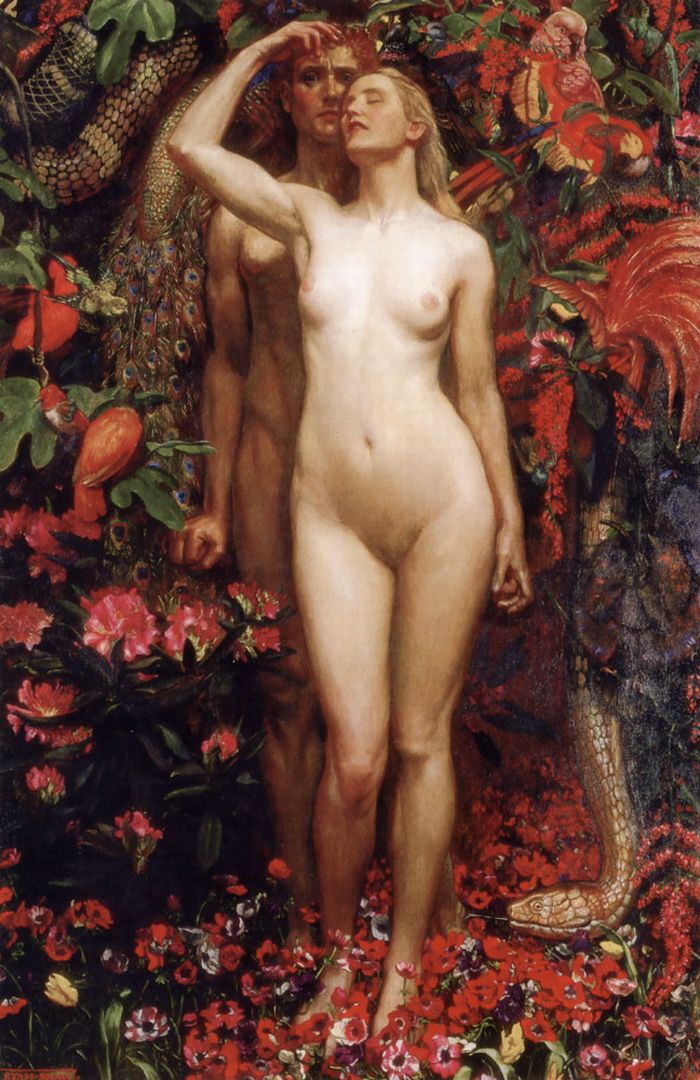
John Byam Shaw: The woman, The man And The Serpent

It is the hour when from the boughs 
The nightingale's high note is heard; 
It is the hour -- when lover's vows 
Seem sweet in every whisper'd word; 
And gentle winds and waters near, 
Make music to the lonely ear. 
Each flower the dews have lightly wet, 
And in the sky the stars are met, 
And on the wave is deeper blue, 
And on the leaf a browner hue, 
And in the Heaven that clear obscure 
So softly dark, and darkly pure, 
That follows the decline of day 
As twilight melts beneath the moon away.
(George Gordon Byron)


(Deep Purple - Son of Alerik)

Tuesday, 30 July 2013

Blind leading the blind...

Pieter Brueghel: Blind leading the blind

I had a dream, which was not all a dream.
The bright sun was extinguish'd, and the stars
Did wander darkling in the eternal space,
Rayless, and pathless, and the icy earth
Swung blind and blackening in the moonless air;
Morn came and went—and came, and brought no day,
And men forgot their passions in the dread
Of this their desolation; and all hearts
Were chill'd into a selfish prayer for light:
And they did live by watchfires—and the thrones,
The palaces of crowned kings—the huts,
The habitations of all things which dwell,
Were burnt for beacons; cities were consum'd,
And men were gather'd round their blazing homes
To look once more into each other's face;
Happy were those who dwelt within the eye
Of the volcanos, and their mountain-torch:
A fearful hope was all the world contain'd;
Forests were set on fire—but hour by hour
They fell and faded—and the crackling trunks
Extinguish'd with a crash—and all was black.
The brows of men by the despairing light
Wore an unearthly aspect, as by fits
The flashes fell upon them; some lay down
And hid their eyes and wept; and some did rest
Their chins upon their clenched hands, and smil'd;
And others hurried to and fro, and fed
Their funeral piles with fuel, and look'd up
With mad disquietude on the dull sky,
The pall of a past world; and then again
With curses cast them down upon the dust,
And gnash'd their teeth and howl'd: the wild birds shriek'd
And, terrified, did flutter on the ground,
And flap their useless wings; the wildest brutes
Came tame and tremulous; and vipers crawl'd
And twin'd themselves among the multitude,
Hissing, but stingless—they were slain for food.
And War, which for a moment was no more,
Did glut himself again: a meal was bought
With blood, and each sate sullenly apart
Gorging himself in gloom: no love was left;
All earth was but one thought—and that was death
Immediate and inglorious; and the pang
Of famine fed upon all entrails—men
Died, and their bones were tombless as their flesh;
The meagre by the meagre were devour'd,
Even dogs assail'd their masters, all save one,
And he was faithful to a corse, and kept
The birds and beasts and famish'd men at bay,
Till hunger clung them, or the dropping dead
Lur'd their lank jaws; himself sought out no food,
But with a piteous and perpetual moan,
And a quick desolate cry, licking the hand
Which answer'd not with a caress—he died.
The crowd was famish'd by degrees; but two
Of an enormous city did survive,
And they were enemies: they met beside
The dying embers of an altar-place
Where had been heap'd a mass of holy things
   For an unholy usage; they rak'd up,
And shivering scrap'd with their cold skeleton hands
The feeble ashes, and their feeble breath
Blew for a little life, and made a flame
Which was a mockery; then they lifted up
Their eyes as it grew lighter, and beheld
Each other's aspects—saw, and shriek'd, and died—
Even of their mutual hideousness they died,
Unknowing who he was upon whose brow
Famine had written Fiend. The world was void,
The populous and the powerful was a lump,
Seasonless, herbless, treeless, manless, lifeless—
A lump of death—a chaos of hard clay.
The rivers, lakes and ocean all stood still,
And nothing stirr'd within their silent depths;
Ships sailorless lay rotting on the sea,
And their masts fell down piecemeal: as they dropp'd
They slept on the abyss without a surge—
The waves were dead; the tides were in their grave,
The moon, their mistress, had expir'd before;
The winds were wither'd in the stagnant air,
And the clouds perish'd; Darkness had no need
Of aid from them—She was the Universe.

(Darkness, By George Gordon Byron)

(Blind Orphans - Scars in the Depth of my Mind)

Monday, 22 July 2013

Ars Longa, Vita Brevis...

John Haynes-Williams - Ars Longa, Vita Brevis 1877

Shed no tear! oh, shed no tear!
The flower will bloom another year.
Weep no more! oh, weep no more!
Young buds sleep in the root's white core.
Dry your eyes! oh, dry your eyes!
For I was taught in Paradise
To ease my breast of melodies,--
Shed no tear.

Overhead! look overhead!
'Mong the blossoms white and red--
Look up, look up! I flutter now
On this fresh pomegranate bough.
See me! 'tis this silvery bill
Ever cures the good man's ill.
Shed no tear! oh, shed no tear!
The flower will bloom another year.
Adieu, adieu -- I fly -- adieu!
I vanish in the heaven’s blue,--
Adieu, adieu!
(John Keats - A faery song)

Vivaldi Bassoon Concerto in E minor, RV484
Mvt 1


Mvt 2


Mvt 3

Wednesday, 17 July 2013

Medieval Steel (by the Warrior Queen)

Frank Frazetta:  Woman with skythe

(Alfred Tennyson - Sir Galahad)
My good blade carves the casques of men,
My tough lance thrusteth sure,
My strength is as the strength of ten,
Because my heart is pure.
The shattering trumpet shrilleth high,
The hard brands shiver on the steel,
The splinter’d spear-shafts crack and fly,
The horse and rider reel:
They reel, they roll in clanging lists,
And when the tide of combat stands,
Perfume and flowers fall in showers,
That lightly rain from ladies’ hands.

Warrior Queen (my friend Mary) - Medieval Steel : 

Monday, 15 July 2013

On the sea...

Sir Edward John Poynter: The cave of the storm nymphs

It keeps eternal whisperings around
Desolate shores, and with its mighty swell
Gluts twice ten thousand Caverns, till the spell
Of Hecate leaves them their old shadowy sound.

Often 'tis in such gentle temper found,
That scarcely will the very smallest shell
Be moved for days from where it sometime fell.
When last the winds of Heaven were unbound.

Oh, ye! who have your eyeballs vexed and tired,
Feast them upon the wideness of the Sea;
Oh ye! whose ears are dinned with uproar rude,
Or fed too much with cloying melody---

Sit ye near some old Cavern's Mouth and brood,
Until ye start, as if the sea nymphs quired! 

(On the sea - By John Keats)


(Agent Steel - Traveler)